
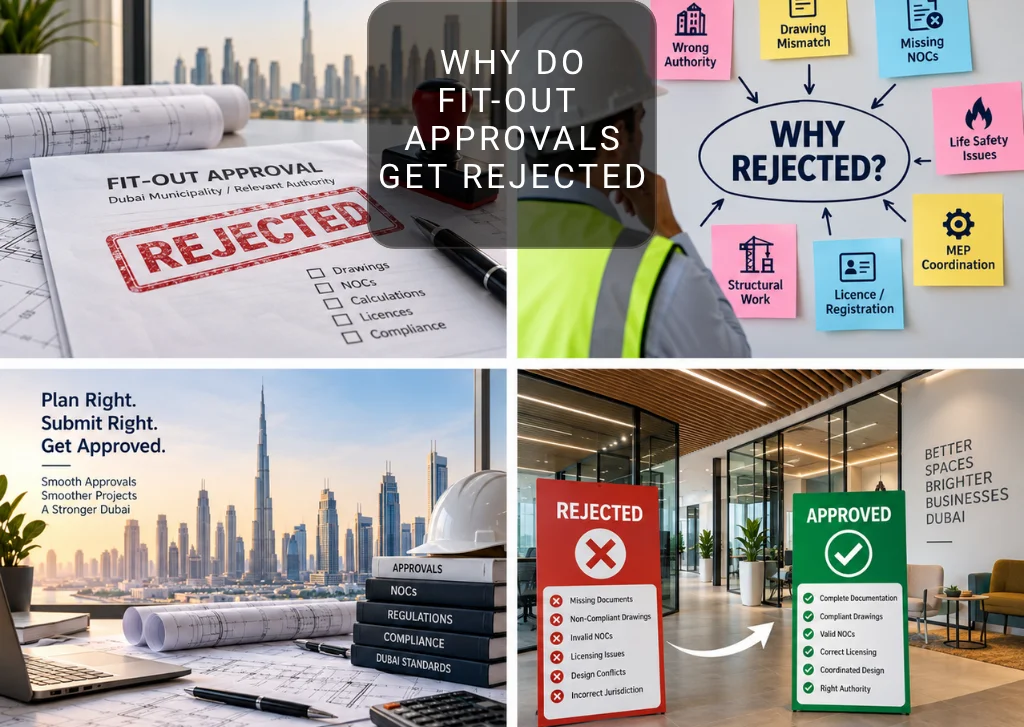
Fit-out approvals get rejected in Dubai for reasons that often have little to do with the appearance of the finished space. Wrong authority selection, mismatched drawings, incomplete NOCs, outdated life-safety calculations, and licensing issues can all delay a well-prepared project. Knowing the common fit-out application rejection reasons helps tenants fix problems before they reach formal review.
1. Submitted to the Wrong Authority or Jurisdiction
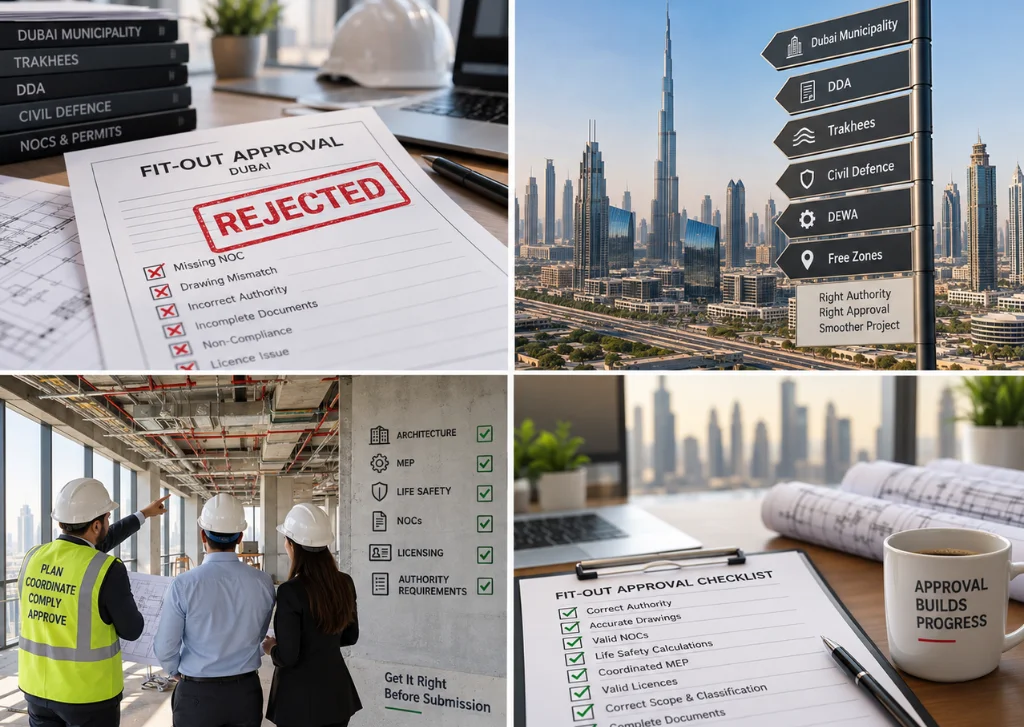
Not sure which authority applies to you? Confirm the regulator responsible for the specific property before preparing drawings, because Dubai has different approval routes for mainland, free-zone, and development-specific areas.
Depending on location, the project may fall under Dubai Municipality, Dubai Development Authority, Trakhees, or another competent framework. A rejected fit-out permit case can therefore start with the wrong jurisdiction rather than a design error.
Check the plot, building-management requirements, and previous approval records at the beginning. This prevents you from designing against the wrong standards or collecting documents for the wrong application route. It also gives your consultant a clear basis for the Dubai fit-out permit process.
2. Drawings Don’t Match the Approved Base-Building Documents
The authority needs a reliable picture of what is already approved and what you are proposing to change. Your drawings should match the latest approved base-building information, including the unit boundaries, existing layout, and relevant configuration. This is also a simple way to prevent a fit-out drawing rejection caused by a baseline mismatch.
Do not assume an old CAD file still reflects the approved condition. Verify the site, compare it with the approved documents, and clearly show proposed changes before issuing the package. For DDA projects, separating approved and proposed information is particularly important for fit-out drawings approval.
3. Generic, Missing, or Expired NOCs
A fit-out submission can be returned when a required NOC is missing, expired, or does not properly support the proposed scope. Building-owner approval is commonly required, while Civil Defence, utilities, developers, community management, or other bodies may also be involved depending on the work. A fit-out NOC rejection can therefore happen even when the drawings are technically sound.
Treat each NOC as a controlled document with an issuer, date, validity period, and defined scope. Before submission, check the signatory, wording, expiry date, and whether the proposed work is actually covered by the approval. This small review can prevent an administrative issue from creating another submission cycle.
4. Occupancy Load and Escape Routes Not Recalculated
Occupancy and escape calculations must be reviewed when layout or use changes affect how many people use the space or how they exit it. New partitions can alter travel distance, dead ends, exit widths, room capacity, and access to protected exits. Reusing old calculations can therefore create fit-out non-compliance even when the new walls seem minor.
Review the proposed use, occupant load, travel paths, exit capacity, door swing, and other applicable fire-safety requirements. Give extra attention to F&B, retail, classrooms, training rooms, and other spaces with higher or different occupant densities. It is safer to complete these checks during design than to wait for a reviewer to request them.
5. MEP Not Coordinated With the Architectural Drawings
Architectural and MEP drawings should describe the same buildable space before submission. A ceiling change can affect sprinklers and detectors, a partition can block ductwork, and a wet area can conflict with drainage or water services. These clashes can turn one issue into revisions across several disciplines.
Run a coordination check across ceilings, partitions, HVAC, plumbing, electrical, fire protection, equipment, and required clearances. Pay particular attention to kitchens, server rooms, medical areas, and other technically demanding spaces. The goal is one coordinated solution rather than separate drawings that work only on paper.
6. Consultant, Contractor, or Trade Licence Doesn’t Match the Work
The project team must be eligible for the work, and the licensed business activity must match the intended use of the premises. A consultant or contractor may hold a valid licence but still need registration or authority-specific eligibility for the project. Likewise, fitting out an office for F&B without resolving the licensing position can stop the application.
Verify current registrations, authorizations, and permitted scope before appointment, then compare the intended use with the tenant’s trade licence. Where necessary, resolve the licence or change-of-use issue before investing heavily in detailed design. These checks are far cheaper at kickoff than after submission.
7. Structural Work Misclassified as Simple Fit-Out
Structural work should not be treated as ordinary interior fit-out when it changes the building structure, floor area, or regulated use. Examples can include a new staircase, structural elements, additional gross floor area, or certain changes of use. In such cases, a building modification permit route may be required instead of a standard fit-out application.
Misclassification can lead to redesign, new calculations, additional NOCs, and repeat fees. Review the scope with the responsible consultant before selecting the permit type, especially where floor, structure, or area are affected. Correct classification at the start is much easier than changing the route halfway through a project.
What a Rejected Fit-Out Application Actually Costs You
The cost of rejection usually extends beyond the authority fee because the project may also absorb redesign, consultant time, delayed purchasing, contractor disruption, and lost operating time.
Revised drawings, recalculations, replacement documents, or another review cycle may all be required. Therefore, the fit-out approvals that get rejected can affect the whole fit-out programme, not just the approval task.
There is no single Dubai-wide rejection cost because the amount depends on the authority, project, and reason for rejection. Some authorities publish specific permit and revision fees, while redesign and delay costs are project-specific. The real saving comes from finding the problem before submission rather than paying to correct it afterward.
What to Do If Your Fit-Out Approval Gets Rejected?
If your interior fit-out approval gets rejected, first, read every authority comment and identify the root cause instead of changing random items. Separate technical issues from administrative problems, then correct the drawings, documents, calculations, NOCs, licensing, registration, or approval route that caused the return.
When fit-out approvals get rejected, fixing only the most obvious comment can leave the underlying problem untouched.
Before sending the package again, review every revised drawing and supporting document together. Confirm that the NOCs, licences, professional details, calculations, and application information still match the revised scope.
For fit-out permit resubmission, follow the specific authority’s portal and application-reference rules rather than assuming every Dubai authority uses the same process.
How to Avoid Fit-Out Rejection in Dubai
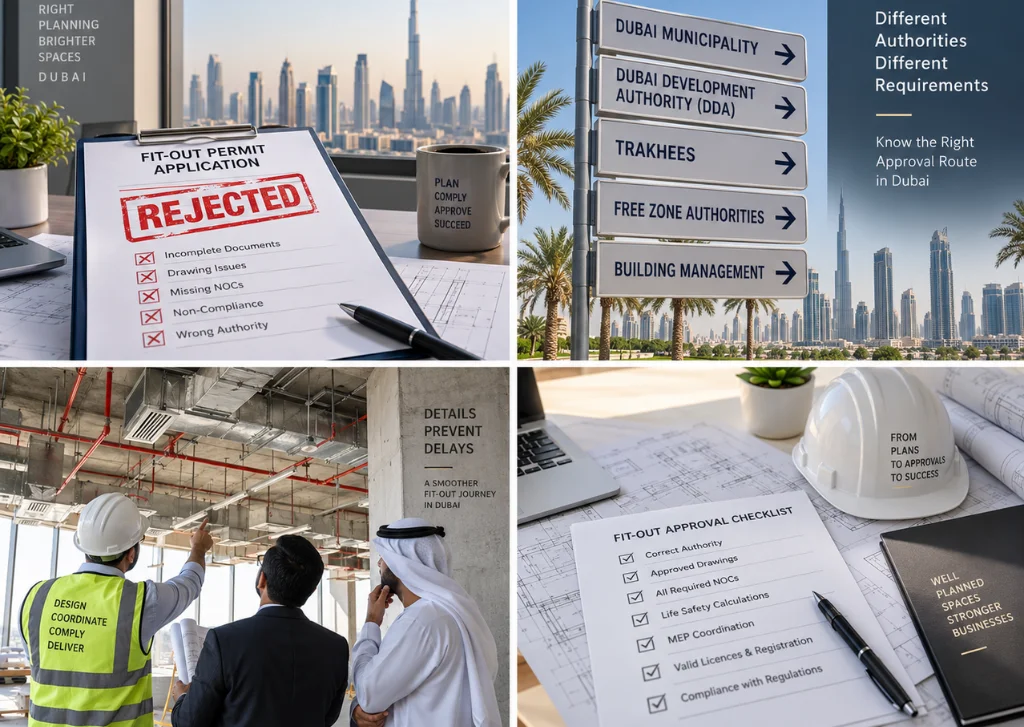
The safest approach is to treat approval readiness as a checklist that starts before the drawings are finalized. Confirm the jurisdiction, verify the approved baseline, map required NOCs, check licences and registrations, recalculate life-safety requirements, coordinate MEP, and determine whether structural or change-of-use work needs another route.
Atech Interiors LLC can support clients with fit-out approval services in Dubai while these technical and authority requirements are coordinated.
Use this final check before submission:
- Confirm the correct authority and submission route
- Match the proposed layout with approved base-building information
- Check every NOC, licence, authorization, and validity date
- Recalculate occupancy, exits, and travel distances
- Coordinate architectural, MEP, fire, and structural information
- Verify consultant and contractor eligibility
- Confirm the licensed activity matches the intended use
- Check whether structural work or change of use needs a different permit
- Review current authority drawing and file requirements
- Plan the inspection and fit-out completion certificate Dubai process
Conclusion
Fit-out approvals get rejected most often when one part of the application does not match another, whether that is the jurisdiction, approved baseline, NOC, calculation, technical design, registration, or intended use.
Most of these risks can be identified before submission with a disciplined review. The aim should be to submit a complete and consistent package, not simply the fastest possible package.
Confirm the route, verify the existing condition, coordinate the design, validate the documents, and classify the work correctly before upload.
When Fit-out approvals get rejected, the time and money lost are often much greater than the effort required for a proper pre-submission check. Knowing why Fit-out approvals get rejected also makes it easier to build the right checks into the project from day one. Good approval planning is therefore part of good fit-out delivery.
FAQs – Frequently Asked Questions
1. What’s the difference between a technical rejection and a compliance rejection?
A technical rejection usually concerns the design or engineering solution, while a compliance rejection concerns requirements such as jurisdiction, documents, licensing, registration, or approvals.
2. Does using the same consultant on a resubmission reduce the chance of another rejection?
Using the same consultant does not automatically reduce the chance of another rejection. It can help because the consultant already knows the project and previous comments, but only if the underlying problems are properly corrected.
3. Is a fit-out rejection recorded against the unit/building, or only against the applicant?
There is no single Dubai-wide rule that makes every rejection record work in exactly the same way across all authorities. However, approval history, drawings, permits, and property information can remain relevant to later work on the premises. Keep the rejection comments and revised documents with the project record so future submissions start from accurate information.
4. Do I get a refund on fit-out permit fees if the application is rejected?
A refund is not automatically guaranteed because fee rules depend on the authority and service involved. For example, DDA states that when a fit-out submission is determined to require building modification, the fit-out fee is not refunded. Check the current fee conditions for your specific authority before assuming a rejected application will be refunded.
5. Is there a limit on resubmitting a rejected fit-out application?
There is no single resubmission limit that applies to every Dubai authority and fit-out service.