
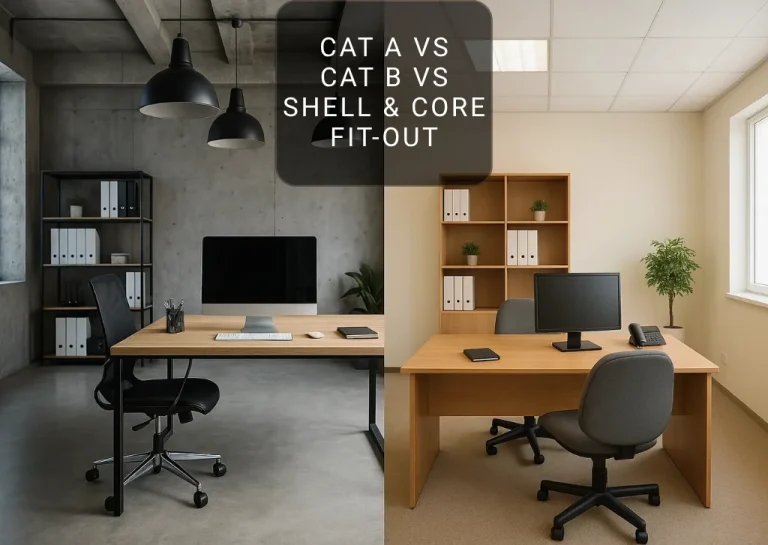
Not sure whether you should lease a Shell & Core, Cat A, or Cat B office in Dubai? The biggest mistake is choosing a space based only on its rent or the label used by the landlord, because the handover condition determines how much more you will spend on fit-out, how long your office will take to complete, and how much control you have over the final design.
Cat A vs Cat B vs Shell & Core Fit-Out Dubai is therefore really a question of what you receive on day one and what remains for you to build.
In simple terms, Shell & Core gives you the base building, Cat A adds essential internal services, and Cat B creates the finished workplace. The difference is especially important when comparing offices in DIFC, Business Bay, JLT, or Dubai Internet City, because the same category can have different specifications from one building to another.
This guide explains what each stage includes, who pays, typical Dubai costs and timelines, required approvals, and which option makes the most sense for your business.
Shell & Core, Cat A, and Cat B — How the Three Stages Relate
The usual progression is Shell & Core → Cat A → Cat B. Cat A vs Cat B vs Shell & Core Fit-Out Dubai is best understood as a sequence: Shell & Core provides the base structure, Cat A prepares the tenant area technically, and Cat B creates the business-specific workplace.
A Cat A tenant normally focuses on Cat B works, while a Shell & Core tenant may have to fund both the basic infrastructure and the final fit-out.
What Shell & Core Includes
Shell & Core generally includes the building structure, facade, roof, core areas, central plant, and shared building infrastructure, while the tenant area remains mostly unfinished. Depending on the property, you may receive plain floors, exposed ceilings, unfinished walls, and only main service connections rather than a completed internal MEP system.
Its main advantage is freedom: you can design the workplace and engineering around your own requirements. The trade-off is higher upfront investment and a longer project because more design, approvals, MEP work, and construction remain. A shell and core building therefore suits businesses planning a long-term, highly customised workplace.
What Cat A Includes
Cat A normally provides a neutral technical base, including raised or finished flooring, basic ceilings, lighting, HVAC, electrical distribution, and fire-safety systems. Depending on the building, it may also include basic wall finishes, plumbing, and core washrooms.
It normally does not include private offices, meeting rooms, reception branding, furniture, or a tenant-specific layout. That is why Cat A can look finished without being ready for your actual operations. Always request the landlord’s written Cat A specification because the scope varies between buildings.
What Cat B Includes
Cat B is where the space becomes your actual workplace. It can include partitions, meeting rooms, reception, final flooring, feature ceilings, lighting, pantry facilities, joinery, furniture, branding, data cabling, AV, and access-control systems.
It can also modify MEP services to suit the final layout. Moving rooms may require changes to HVAC, lighting, power, sprinklers, or fire detection, so Cat A vs Cat B fit-out is not simply a comparison of finishes; it is a comparison of technical and operational scope.
Cat A vs Cat B vs Shell & Core: Side-by-Side Comparison
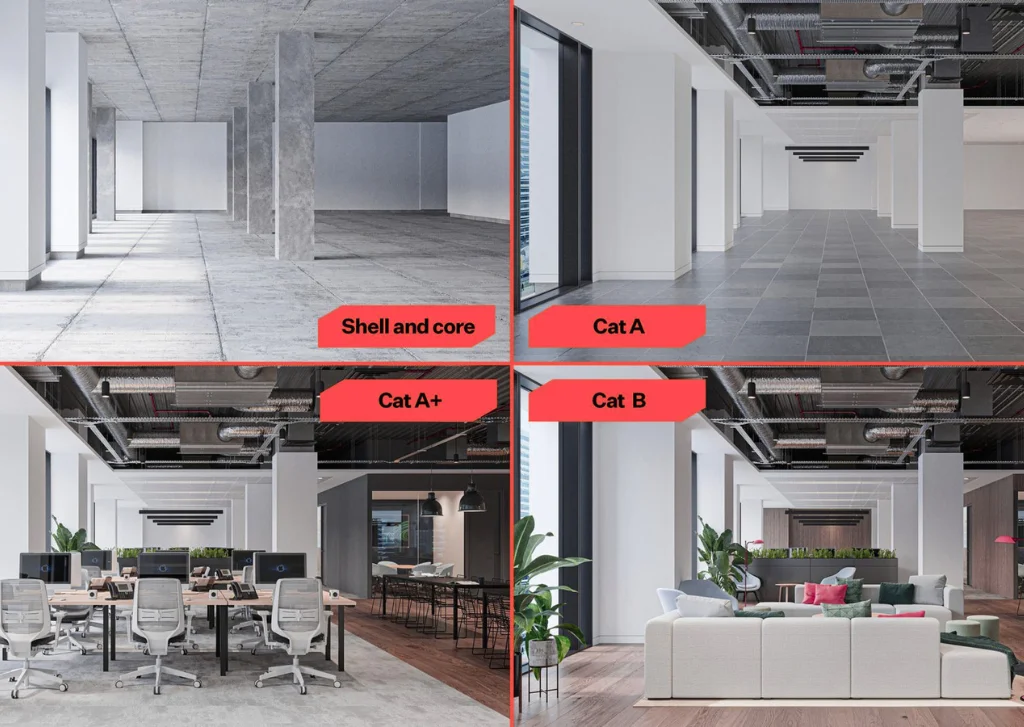
A complete Cat A vs Cat B vs Shell & Core comparison is as follows:
The practical Cat A vs Cat B office difference is therefore not just how the space looks. Cat A gives you infrastructure; Cat B turns that infrastructure into an office designed around your people, workflow, and brand.
Who Pays for Cat A vs Cat B — Landlord or Tenant?
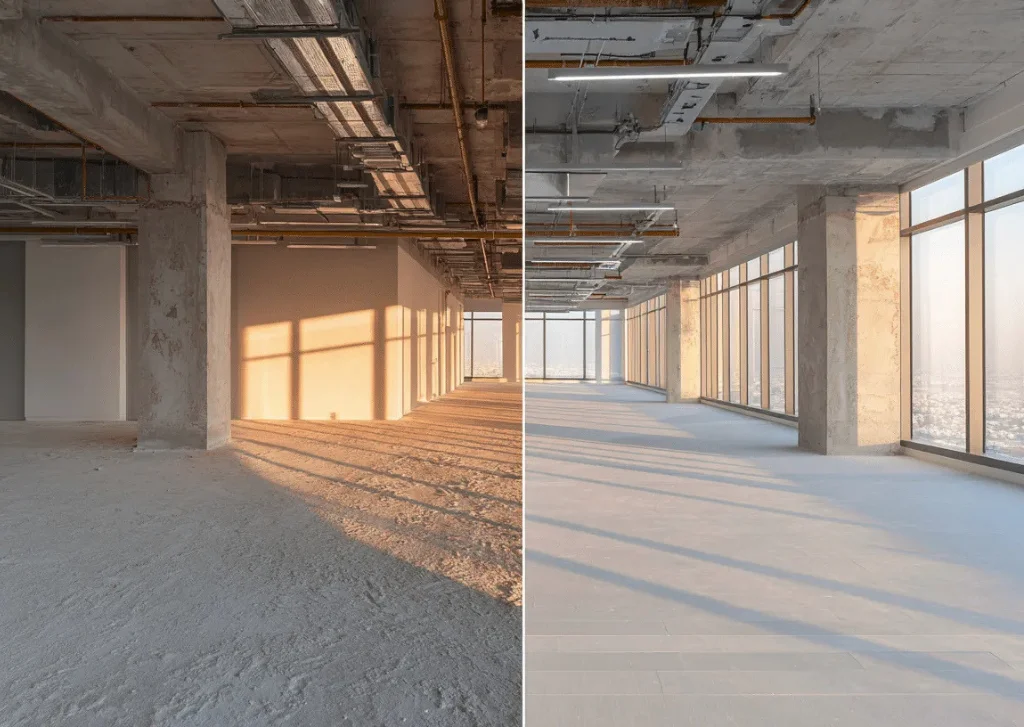
Normally, the landlord or developer provides the base building and Cat A, while the tenant pays for Cat B. However, Dubai landlords may offer fit-out contributions, rent-free periods, or enhanced handover packages as part of lease negotiations.
Do not rely on the category name alone. The lease should state the exact handover condition, landlord contribution, approval responsibilities, and restoration requirements. Dubai tenancy law also makes landlord permission and required official approvals relevant to tenant alterations.
Is Cat A+ a Real Category in Dubai?
Cat A+ is a recognised market term, but it is not a formal regulatory classification. It generally means a landlord has added selected tenant-use features to Cat A, such as partitions, meeting rooms, pantry facilities, cabling, or workstations.
The exact package varies, so ask for a detailed inclusion list before comparing it with Cat A or Cat B. A Cat A+ fit-out can reduce upfront CAPEX and move-in time, but you normally sacrifice some design control.
How Much Does a Cat A or Cat B Fit-Out Cost in Dubai?
A useful 2026 planning range is around AED 200–450 per sq ft for Cat A. Cat B commonly ranges from AED 180–300 for budget work, AED 350–550 for mid-range offices, and AED 600–900+ for premium projects, with specialist high-end work potentially exceeding AED 1,000 per sq ft.
These are benchmarks, not quotations. A Cat A fit-out vs. Cat B comparison is only meaningful when both quotes include the same scope for MEP, approvals, joinery, furniture, IT, and design. For an accurate budget, survey the unit first and price the actual scope.
Approvals You Need for a Cat B Fit-Out in Dubai
A Cat B project commonly needs a landlord/building NOC plus approvals applicable to the property’s jurisdiction, which may involve Dubai Municipality (DM), Dubai Civil Defence (DCD), and DEWA. The exact route depends on location, free-zone rules, and the work being proposed.
This matters because new partitions can affect sprinklers, smoke detection, escape routes, HVAC, and electrical loads. DEWA’s fit-out process also requires relevant technical load and wiring information for applicable connections.
How Long Does a Shell & Core, Cat A, and Cat B Fit-Out Take in Dubai?
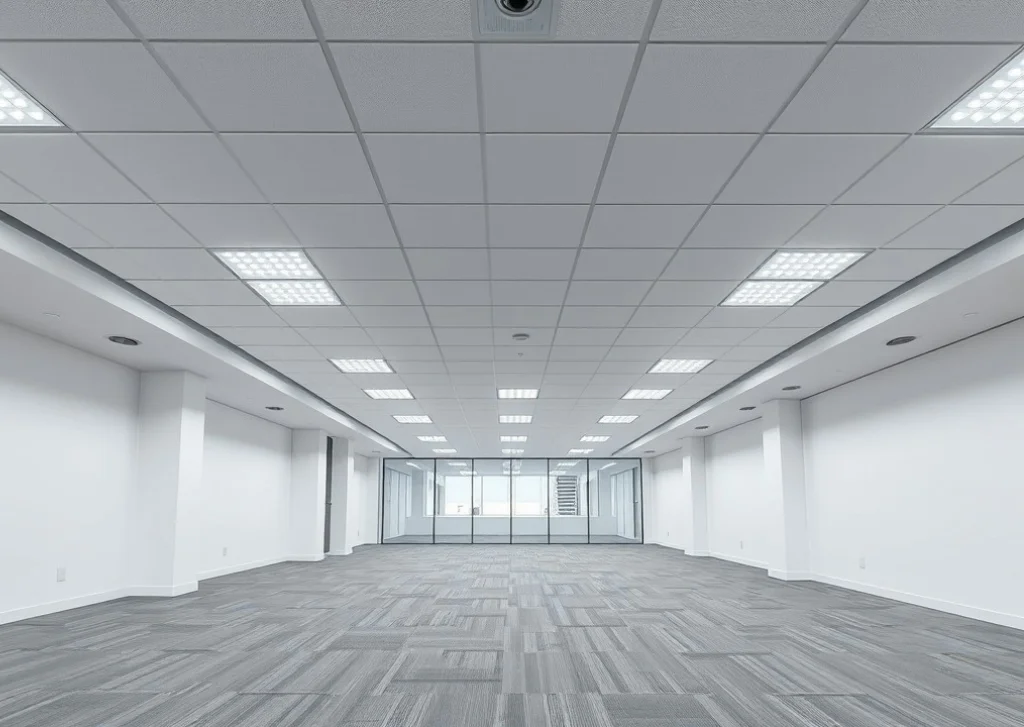
There is no fixed duration because size, design, approvals, purchasing, and building restrictions all affect the programme. Shell & Core normally takes the longest from the tenant’s perspective because both the technical base and final workplace may still need to be completed.
A straightforward Cat B construction phase can take roughly 6 – 10 weeks, while the broader design-to-handover programme can reach 8 – 16 weeks when approvals, purchasing, testing, final inspection, and handover are included. Plan the full programme, not just the number of construction days.
How to Decide Which Fit-Out Category You Need
The right choice depends on your starting condition, CAPEX, deadline, lease length, desired control, and future growth. Cat A vs Cat B vs Shell & Core Fit-Out Dubai should therefore be judged by total business value rather than simply the lowest rent or fit-out rate.
Startups/SMEs
Cat A, Cat A+, or ready offices can suit businesses that prioritise low upfront spending and fast occupancy. Shell & Core makes more sense when the company has a longer lease and needs a highly customised workplace.
Established Corporates
Established businesses often justify Cat B because they may need stronger branding, acoustics, specialist IT, client-facing spaces, and long-term workplace efficiency. Starting from Cat A can provide the right balance between base infrastructure and design control.
Retail
Retail needs stronger attention to shopfronts, displays, lighting, signage, joinery, and brand guidelines. F&B projects may also need significantly more MEP capacity because of commercial kitchens and specialist equipment.
Common Mistakes at the Shell & Core to Cat B Handover
The biggest problems usually occur when the tenant designs around assumptions instead of the actual handover condition. Cat A vs Cat B vs Shell & Core Fit-Out Dubai should always be checked against the lease, drawings, specifications, and physical site.
- Assuming every Cat A is identical: Get the landlord’s detailed scope
- Skipping a site survey: Compare documents with the actual condition
- Ignoring existing MEP: Check HVAC, power, lighting, sprinklers, and fire systems before finalising the layout
- Starting before approvals: Secure required NOCs and permits first
- Forgetting reinstatement: Confirm what must be removed at lease expiry
- Replacing usable infrastructure: Unnecessary demolition adds cost and risk
- Ignoring capacity: Specialist equipment may require extra power or cooling
- Comparing quotations by rate alone: Check exactly what each quotation includes
FAQs – Frequently Asked Questions
1. Is “Grade A office” the same as “Cat A fit-out”?
No. Grade A describes the quality or market positioning of a building, while Cat A describes the physical fit-out condition of a space. A Grade A building can therefore offer Shell & Core, Cat A, Cat A+, or fully fitted offices.
2. Can I use my own contractor for a Cat B fit-out, or must I use the landlord’s approved list?
You can often appoint your own contractor, but the building may require specific licensing, insurance, technical approvals, or inclusion on an approved list. Check the building’s fit-out manual before making an appointment.
3. Does a Cat B fit-out change my DEWA or service/cooling charges?
It can. Server rooms, dense meeting areas, and specialist equipment may increase electrical or cooling demand, so available capacity should be checked before finalising the design.
4. Can I negotiate a rent-free period to cover my Cat B fit-out costs?
Yes. A rent-free period or fit-out contribution can be negotiated depending on the landlord, building, market conditions, lease length, and tenant profile. Compare the entire incentive package rather than rent alone.
5. Is VAT charged on fit-out and construction costs in the UAE?
Generally, VAT-registered suppliers charge the standard 5% UAE VAT on taxable fit-out and construction services unless a specific VAT treatment applies. Check whether quotations are VAT-inclusive or exclusive.
6. What’s the difference between a “warm shell” and a “cold shell”?
A warm shell generally has more basic services brought into the tenant area, while a cold shell is a more stripped-back condition. These terms are not completely standard across Dubai, so always compare the landlord’s actual scope rather than relying on the label.